Choosing an Amplifier for High-Impedance Headphones
 Cynthia Kuder
Look for voltage swing and a low output impedance, and a high-impedance headphone becomes straightforward to drive. The 250 to 600 ohm region is not difficult to amplify; it is simply a different requirement from the low-impedance loads that portable gear is designed around.
Why high impedance changes the requirement
A high-impedance headphone draws little current for a given voltage. The amplifier therefore needs to supply a large voltage swing rather than a large current, which is the opposite of what a low-impedance load demands.
Portable devices are built around low-impedance earbuds and are usually limited in supply voltage. They can deliver current from a small battery rail but cannot swing the tens of volts that a 600-ohm load may need.
This is why the same headphone can sound thin from a phone and full from a desktop amplifier that costs less than the phone.
Calculate the swing you need
Take the headphone’s sensitivity in dB per milliwatt, convert to dB per volt using the impedance, and work out the voltage needed for your target level.
A 300-ohm headphone at 97 dB/mW needs roughly 1 volt for 100 dB, and 3 volts for 110 dB. Peaks in recorded music add another 15 to 20 dB, so a practical requirement approaches 10 to 15 volts.
A 600-ohm headphone at 94 dB/mW needs more, approaching 20 volts for the same peaks. Those figures explain why a supply voltage of plus and minus 12 volts is a common design point for desktop amplifiers.
Current still matters
A high-impedance load draws less current, but it is not zero. An amplifier that swings the voltage but cannot maintain it under load will compress on peaks rather than clipping cleanly.
The symptom is music that sounds dynamically flat at high levels while the volume control suggests there is more available. That is a power supply limitation rather than a gain limitation.
Look for a stated output voltage at the headphone’s impedance rather than at a generic load. Where only one load is quoted, the behaviour into a different load is unknown.
Output impedance with a high-impedance load
The one-eighth rule is easier to satisfy here, because the headphone’s own impedance is high. An output impedance of 30 ohms is harmless into a 300-ohm load and would be a problem into a 32-ohm one.
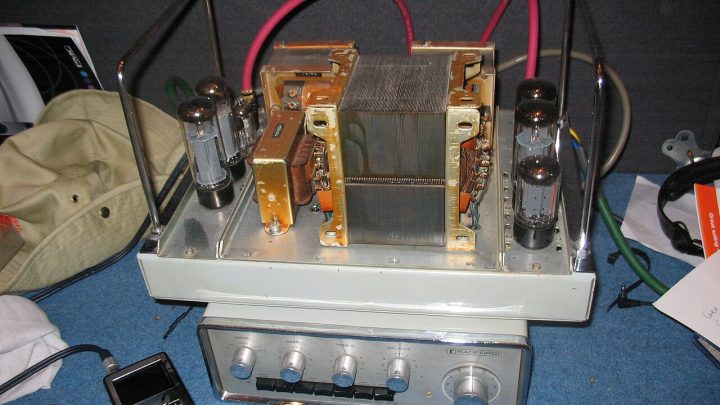
Some valve amplifiers rely on this tolerance, using a transformer or an output capacitor that adds impedance without producing a measurable response change.
The relevant check is the size of the headphone’s impedance peak at resonance. A headphone that rises from 300 to 600 ohms in the bass region will still show a small response shift with a high output impedance, even though the nominal ratio looks acceptable.
Noise floor becomes easier
A high-impedance headphone is less sensitive to the amplifier’s voltage noise, because less current flows and the thermal noise contribution is lower.
A quiet amplifier is still required, but the threshold is far more forgiving than with sensitive in-ears. An amplifier that hisses audibly with a 16-ohm in-ear is frequently silent with a 300-ohm dynamic headphone.
That is why a single amplifier can be praised by one listener and criticised by another. The load changes the noise requirement entirely.
Valve and solid state considerations
Valve amplifiers frequently provide the voltage swing needed and add a high output impedance as a characteristic. The combination works well with high-impedance dynamic headphones and poorly with low-impedance planars.
Solid state amplifiers can achieve the same voltage with a much lower output impedance, which makes them a safer match across different headphones.
The choice between them is a matter of how the output impedance interacts with the specific headphone rather than a general question of which technology is superior.
Testing the pairing
Play a demanding orchestral recording and listen for congestion as the level rises. Congestion that appears suddenly suggests the amplifier is reaching its limits rather than the headphone.
Then reduce the level by 6 dB and listen again. A difference that disappears indicates headroom; a difference that remains points to something else in the chain.
A shortlist of requirements
Fifteen volts of swing, an output impedance under 20 ohms, a gain option for sensitive loads, and a published rating into a load close to your headphone’s impedance.
Those four items cover any high-impedance dynamic headphone in normal use, and they are usually available well below the price of the headphone itself.