Volume Control Methods in Desktop Amplifiers and Where Noise Appears
 Cynthia Kuder
Match the volume control method to your headphone’s sensitivity, because the type of attenuator decides where the noise and the channel imbalance appear. Four common arrangements behave differently, and the wrong one for your load produces audible problems that no amount of upgrading fixes.
The passive potentiometer
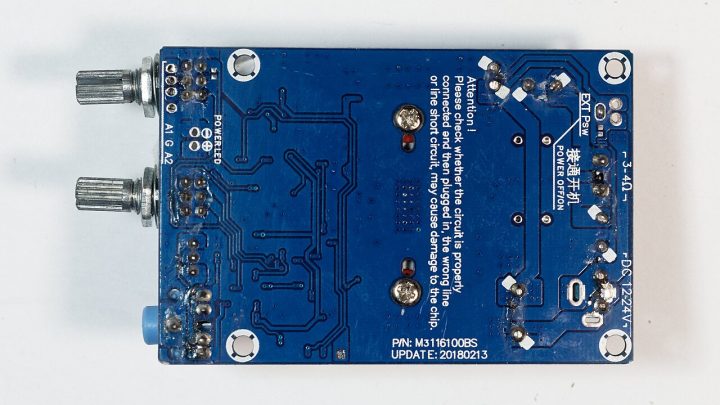
A carbon potentiometer is the most common and the least expensive. It attenuates the signal before the amplifier stage, which means the amplifier always applies its full gain to whatever voltage is left.
The problem is channel tracking. Two resistive tracks are difficult to match at the bottom of their travel, so at low settings one channel can be a decibel or more louder than the other.
The remedy is to run the control higher in its range. Using the upper half of the travel keeps the tracking error small and the noise contribution low.
Stepped attenuators
A stepped attenuator switches between discrete resistors rather than sliding along a track. Channel matching is far better because each position uses a matched pair.
The trade-off is granularity. A 24-step control often moves in 2 dB increments, which can be too coarse for sensitive in-ears that only need the first four steps.
Stepped attenuators also click audibly between positions, which is irrelevant while listening and noticeable when adjusting during a quiet passage.
Relay-switched resistor networks
A relay network gives the matching of a stepped attenuator with finer increments and remote control. The signal path passes through a resistor pair selected by a relay rather than through a long switch.
The noise contribution is very low, which suits sensitive headphones. The cost is complexity, and the relays are audible as faint clicks when the control moves.
Where a remote is offered, the network is usually the reason. It provides attenuation close to the input without long cable runs to a front panel control.
Digital volume in the DAC
A digital control multiplies each sample by a coefficient rather than reducing a voltage. That is precise and free of tracking error, and it has one significant limitation.
Attenuation reduces the number of significant bits. Reducing the level by 30 dB in a 16-bit stream leaves roughly 6 bits of resolution for quiet passages, which is why digital volume controls at low settings often sound flat.
Where the converter operates internally at 32 bits, the practical limit is far lower and digital attenuation becomes safe. The specification usually states the internal precision.
Gain switching as a substitute
An amplifier with a gain switch lets you choose between a high and a low amplification factor. Choosing the lower setting for sensitive headphones keeps the volume control in its comfortable range.
This is the most effective single improvement available on many desktop amplifiers, and it costs nothing. It directly addresses the over-gain problem that produces most noise complaints.
Some designs offer three settings. For in-ears, the lowest is usually correct; for high-impedance dynamic headphones, the middle; for planar headphones, the highest.
Where each arrangement disappoints
A single-gain amplifier with a carbon potentiometer and a pair of sensitive in-ears is the classic mismatched combination. The volume control sits in the bottom tenth of its travel, one channel is louder, and a faint hiss is always present.
The same amplifier with a 300-ohm dynamic headphone is often perfectly adequate, because the control sits in a useful part of its range and the noise floor is far below the music.
This is why the same amplifier receives both praise and criticism from different reviewers. The load differs, and the volume control arrangement interacts with it.
A practical checklist
Check the amplifier’s gain options, the type of attenuator, and whether the DAC allows safe digital attenuation at your normal listening level.
Then set up so the volume control sits between half and three quarters of its travel. If that is impossible, the gain structure is wrong rather than the amplifier being too loud or too quiet.
Matching to the headphone
For in-ears, prioritise a low gain setting and a stepped or relay-switched control. For high-impedance dynamic headphones, a simple potentiometer is usually fine because the control naturally sits higher.
For planar headphones, the requirement is voltage and current rather than attenuation precision, so the control type matters least of the three cases.