Output Impedance and How It Reshapes a Dynamic Driver
 Cynthia Kuder
Keep the output impedance below one eighth of the headphone impedance and the amplifier stops changing the sound. Above that threshold the amplifier forms a voltage divider with the headphone’s impedance curve, and the result is a frequency response that depends on the amplifier rather than on the headphone.
The voltage divider in plain terms
A dynamic headphone’s impedance varies with frequency. It rises sharply at the driver’s resonant frequency, usually in the low bass, and again in the upper midrange.
When an amplifier has a significant output impedance, the voltage delivered to the headphone varies with that curve. Where the impedance is high, more of the available voltage appears across the headphone; where it is low, less does.
The audible result is a bass boost and a midrange shift, and the size of both depends on the ratio between the output impedance and the headphone impedance.
The one-eighth rule and where it comes from
The rule states that the output impedance should be no more than one eighth of the lowest headphone impedance. At that ratio the response deviation stays under roughly 1 dB, which is close to inaudible.
At a ratio of one to one the deviation can exceed 3 dB, which is clearly audible on a bass-heavy headphone and produces the effect listeners describe as loose or bloated low end.
At a ratio of four to one or higher, the amplifier dominates the response entirely and the headphone’s own tuning is largely lost.
Which headphones are affected most
Dynamic headphones with a high impedance peak are affected most. Many models rise from 40 ohms nominal to well over 100 ohms at the low-frequency resonance.
Planar magnetic headphones have a nearly flat impedance curve, so they are largely immune to output impedance effects. That is one reason they behave consistently across sources.
Balanced armature in-ears are sensitive too, and some multi-driver designs show impedance that falls below 10 ohms. Into a high output impedance they can sound dramatically different from one amplifier to the next.
Why the effect is sometimes preferred
A high output impedance raises the low bass and lifts the upper midrange on some designs. Some listeners hear that as warmth and presence, and a few manufacturers deliberately tune for it.
The problem is consistency. The same amplifier produces a different result on every headphone, so the pairing becomes a lottery rather than a choice.
If the effect is wanted, it is better applied deliberately with an equaliser than accidentally through a mismatch, because the equaliser applies the same correction to any headphone.
Measuring the effect for yourself
Play a slow sweep with the headphone connected through a known high-impedance output and again through a low-impedance output at matched levels.
Listen for the low bass. A rise below 100 Hz followed by a small dip suggests the output impedance is interacting with the resonance peak.
A phone-based measurement is sufficient. Compare the two responses and note the size of the difference; if it exceeds 2 dB the mismatch is worth correcting.
Where high output impedance appears
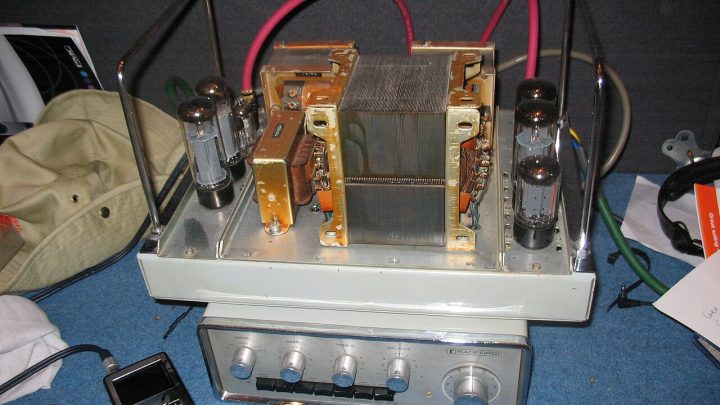
Some tube amplifiers use a transformer with a high output impedance, and the effect is part of their intended character. Others use an output capacitor that adds impedance at low frequencies.
Some portable players and phones have output impedances above 10 ohms, which is why certain multi-driver in-ears sound different on a phone than on a dedicated amplifier.
Professional gear frequently adds a series resistor to protect against short circuits. A 30-ohm series resistor is common and is harmless for high-impedance headphones and significant for low-impedance ones.
What to do about it
Check the specification for the output impedance before buying. Where it is not published, assume it is high enough to matter.
If a pairing sounds bass-heavy or hazy compared with another amplifier, the output impedance is the first thing to investigate rather than a fault in either component.
A practical target
An output impedance under 2 ohms covers every headphone made, including sensitive multi-driver in-ears. Under 4 ohms covers all but the most sensitive, and under 10 ohms is acceptable for headphones above 80 ohms.
Anything above 30 ohms should be treated as a deliberate tuning choice rather than a neutral amplifier.
A quick reference
Under 2 ohms suits everything; under 10 ohms suits headphones above 80 ohms; above 30 ohms should be treated as deliberate tuning rather than as a neutral amplifier.