Desktop Speaker Setups for Nearfield Listening Without Room Treatment
 Cynthia Kuder
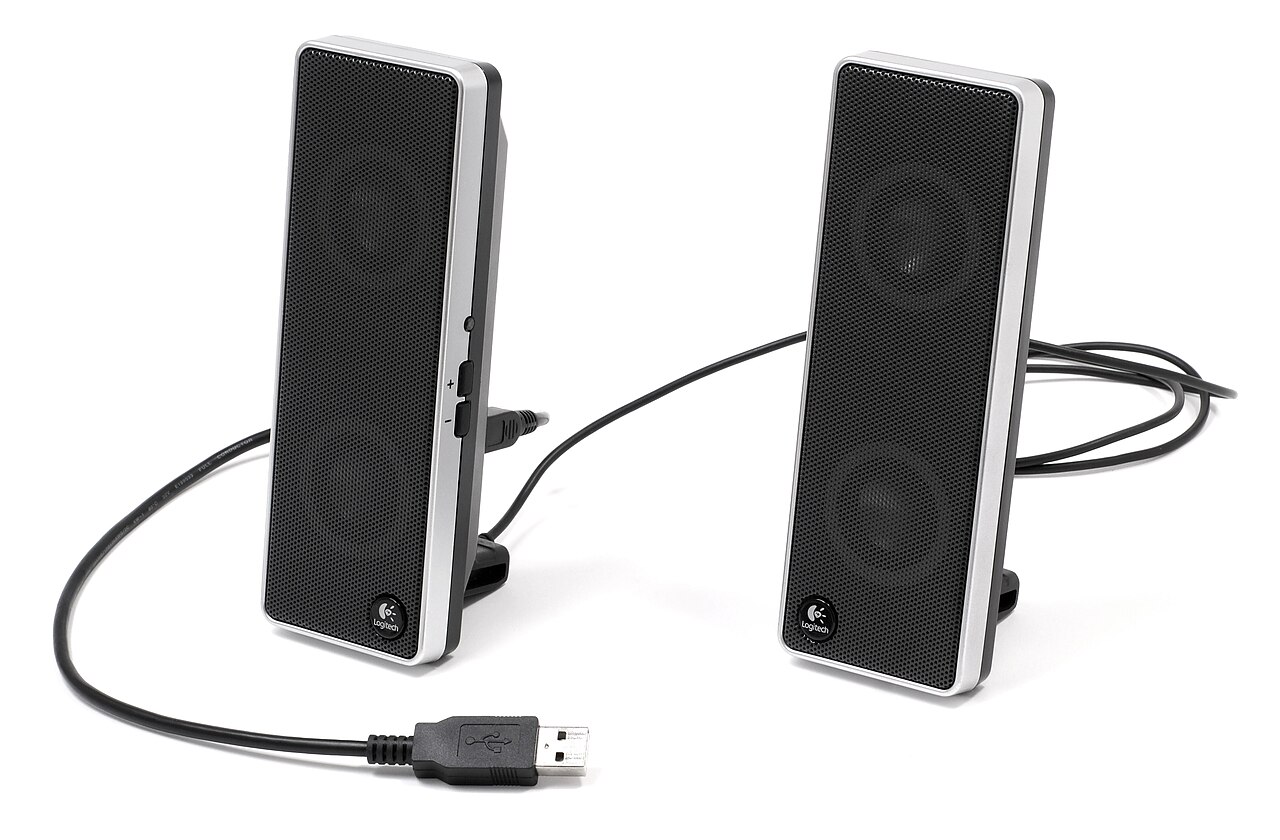
Sit close, keep the speakers off the desk, and a desktop system can outperform a much larger one in an untreated room. Nearfield listening works because the direct sound arrives so much louder than the reflections that the room contributes less to what you hear.
Why distance solves most of the problem
Sound falls off with distance, and reflections do not, so the ratio between direct and reflected sound improves as you move closer to the speakers.
At one metre the direct sound dominates. At three metres in an untreated room the reflections can equal or exceed it, and the room’s character takes over the response.
That is why a small pair of nearfield monitors at close range can sound clearer than a large pair across the room, despite having less bass extension and less output capability.
Get the speakers off the desk
A speaker sitting on a hard desk couples to the surface and produces a reflection that arrives within a fraction of a millisecond. The result is a broad boost in the upper bass and a comb filtering effect in the lower midrange.
Short stands, foam pads or angled wedges all reduce the coupling. Any of them is better than nothing, and the difference is easy to hear on a piano recording.
The stands should also put the tweeter at ear height when you are seated. On most desks that means raising the speaker 10 to 20 centimetres.
Form a triangle and angle inward
Place the two speakers and your head at the corners of an equilateral triangle with sides between 0.8 and 1.2 metres for a typical desk.
Angle the speakers so the tweeter axes point at a spot slightly behind your head. This narrows the listening window but sharpens the centre image, which matters when you sit at a fixed position.
Check for symmetry in the reflections. A monitor on one side and a wall on the other produces an image that leans, and a shelf or a curtain on the near wall can correct it more cheaply than anything electronic.
Deal with the wall behind you
A bare wall directly behind the listener reflects the sound back within a few milliseconds. That reflection interacts with the direct sound and produces a dip in the low midrange that makes voices sound hollow.
A bookshelf, a curtain or a sofa behind the listening position breaks up the reflection at very little cost. Heavy absorption is not required; irregular surfaces help more than smooth ones.
Distance from the rear wall also matters. Sitting further from it reduces the level of the reflection relative to the direct sound, and half a metre is often enough.
Choose the speaker for the desk, not for the room
A nearfield monitor with a controlled directivity pattern is easier to place than a wide-dispersion home speaker, because it puts less energy toward the desk and the side walls.
Front-ported cabinets suit a desk better than rear-ported, because the space behind the speaker is usually small and the rear port would sit too close to the wall.
Small drivers are not a limitation at this distance. At one metre a 10-centimetre driver produces adequate level without exceeding its excursion limit, provided the crossover is well designed.
Adding low frequencies
Small desktop speakers rarely produce useful output below 60 Hz. A subwoofer under the desk extends the range, but its placement is constrained and the crossover needs care.
A subwoofer directly under the desk couples to the desk surface and to the floor, which usually produces uneven results. Placing it to one side and setting the crossover below 80 Hz is often the better compromise.
Headphones remain the practical alternative for anyone who needs full-range reproduction at a desk in a shared space. Nothing else removes the room from the equation as completely.
Verifying the setup
Play a mono recording and check that the centre image is stable when you move your head a few centimetres. Instability indicates an asymmetry in the reflections rather than a problem with the speakers.
Then play a familiar track with a steady bass line and listen for a single note that dominates. A dominant note points to the desk coupling or to a mode excited by the speaker position, and moving the speaker 10 centimetres usually identifies which.