Subwoofer Integration: Crossover, Phase and Level in Order
 Cynthia Kuder
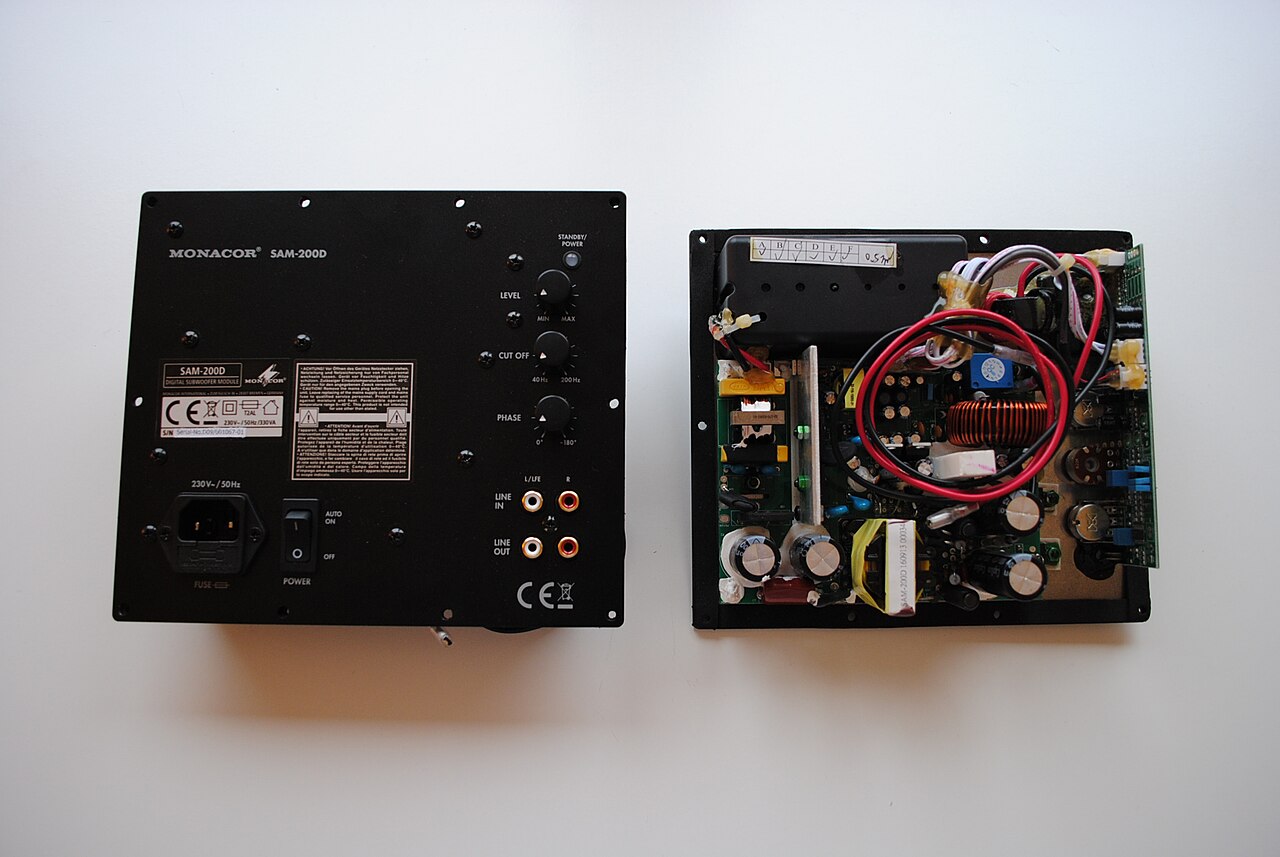
Set the level first, then the crossover, then the phase, and a subwoofer stops sounding like a separate box. Most integration failures come from doing the three in the wrong order, which makes each adjustment impossible to judge.
Level before anything else
Start with the subwoofer at a level where you can barely hear it. Play a familiar track with a continuous bass line and raise the level until the low end just stops sounding thin.
The correct setting is almost always lower than a listener expects on the first attempt. A subwoofer that announces itself is set too loud, and the symptom is a bass line that moves forward while the rest of the music sits behind it.
Judging level requires a steady reference. Use one track repeatedly for this step and do not change the main speaker volume.
Then choose the crossover
The crossover is the frequency above which the subwoofer stops and the main speakers take over. The correct point depends on where the main speakers roll off, not on the number printed on the subwoofer.
If the main speakers reach down to 50 Hz, setting the crossover at 80 Hz is usually right, because the overlap region is where both can contribute. Setting it at 150 Hz makes the subwoofer do work in a range where its position becomes audible.
A subwoofer localised to one corner is a sign the crossover is too high. Above roughly 100 Hz the ear can locate a bass source by its harmonics, and the integration illusion breaks.
Then adjust the phase
The phase control aligns the subwoofer’s output in time with the main speakers. Where the two overlap, correct alignment adds output and incorrect alignment subtracts it.
Play a tone at the crossover frequency and switch the phase control through its range, including the continuous position if there is one. Choose the setting where the tone is loudest at the listening position.
If the effect is unclear, the crossover is probably set too high or too low, and the phase control is then adjusting a region where only one speaker is active. Return to the previous step.
Placement and room modes
A subwoofer in a corner excites every mode and gives the most output with the least evenness. Moving it away from the corner trades output for consistency.
Placing the subwoofer at the listening position and walking the room to find where the bass sounds most even is a known technique. Wherever it sounds best, that is approximately where the subwoofer belongs.
Two subwoofers placed symmetrically reduce the variation across seats considerably. The improvement is usually larger than the improvement from a more expensive single unit, because the problem being solved is the room rather than the driver.
Delay and the mains
Some processors allow a delay to be applied to the main speakers, which achieves the same alignment as the phase control but with greater precision. Where that is available, use it and leave the phase control at zero.
The delay needed is usually a few milliseconds and depends on the distance between the subwoofer and the listening position. Measure the distances rather than estimating, because a metre is roughly three milliseconds.
Checking the result
Sweep from 200 Hz down to 30 Hz and listen for a smooth transition. A dip near the crossover frequency indicates a phase problem; a peak indicates a level problem.
Then listen to a recording with a solo double bass or a piano in the lower register. The instrument should sound like one thing, not like a midrange image with a separate low-frequency foundation.
What to do when nothing works
If the system never integrates, check whether the main speakers are running full range while the subwoofer is also covering the same region. Two sources playing the same frequencies from different positions produce cancellation that no setting can fix.
The correct configuration sends the low frequencies to one place and the rest to another. That usually means a high-pass filter on the main speakers, which some amplifiers provide and some do not.
Cables and connections
A subwoofer needs one signal cable and, where it is active, one mains connection. Everything else is placement.
A long single-ended cable running beside mains wiring can pick up hum that no setting removes. Where the run exceeds a few metres, a balanced connection or a different cable route is worth trying before any adjustment.
A ground loop between the subwoofer and the amplifier appears as a steady hum that does not change with the volume. Connecting both to the same power strip resolves most cases.